The $1,000,000 Invisible Leak
How the fees you pay effect you, and your wealth.
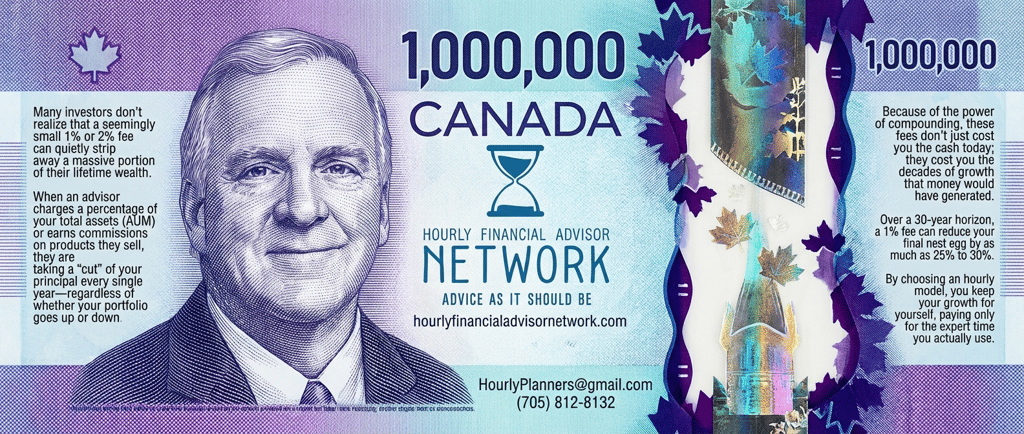

How Fees Can Quietly Erase Future Wealth
One would never think that starting a disciplined savings plan of $2,000 a month at age 35 could eventually cost you over $1,000,000 in lost growth simply due to the way you pay for advice. Most investors focus on the contribution, but the real "silent partner" in your portfolio is the ongoing fee structure. Over a lifetime of investing, a difference of just 1% or 1.5% in annual drag doesn't just take a few dollars out of your pocket today—it strips away the massive compounding power of those dollars over decades.
NOTE: Fees are not the most important part—TOTAL NET RETURNS (After taxes) are what is the most important. One should gladly pay someone a 5% fee to invest their money if they are getting a double-digit return of say 10% to 15% compared to paying a 0.25% fee and only making 4 - 6%. The goal is to maximize what stays in your pocket after everyone else has been paid, and to achieve better then average returns, regardless of how you pay for your advice.
Let’s make this real with one simple example.
Meet Jordan, age 35. Jordan saves $2,000 per month from now until age 65 (30 years). That’s $720,000 of total contributions.
Now we’ll run the exact same savings plan under three different after-tax net return assumptions:
6.0% net return (low ongoing drag)
5.0% net return (1% lower, often the difference between low-cost vs. asset-based fees)
4.5% net return (1.5% lower, common when layered costs show up)
To keep the comparison clean, we’ll assume monthly contributions and monthly compounding, and we’ll ignore withdrawals for the moment so we can isolate the compounding impact of fee drag.
What Jordan has at age 65 (same savings, different net returns)
By age 65, Jordan ends up with approximately:
6.0% net: $1,949,026
5.0% net: $1,630,752
4.5% net: $1,494,128
That means the “small” return differences create a gap of:
6% vs. 5%: $318,274 less by age 65
6% vs. 4.5%: $454,898 less by age 65
Jordan isn’t “out a million” yet at retirement—but the drag is already very real.
So when does the $1,000,000 gap happen?
Here’s the key compounding lesson: the gap accelerates later, when the account balance is largest.
Assume Jordan stops contributing at 65 and simply leaves the money invested (no additional deposits, no withdrawals—again, just to isolate the impact of fee drag). Under those assumptions, the shortfall crosses $1,000,000 at about:
6% net vs. 5% net: around age 77 (about 12.1 years after age 65)
At that point the balances are roughly $3,940,913 vs $2,940,527 (≈ $1,000,385 gap)
6% net vs. 4.5% net: around age 73 (about 8.25 years after age 65)
At that point the balances are roughly $3,152,035 vs $2,148,311 (≈ $1,003,723 gap)
So the answer to “how long before Jordan is out $1,000,000 due to fees?” is:
About 12 years after retirement for a 1% net return drag (6% vs 5%)
About 8 years after retirement for a 1.5% net return drag (6% vs 4.5%)
Why this happens
Fees don’t just reduce your return in a single year—they reduce the amount of money that gets to compound year after year. The larger your portfolio becomes, the more expensive that drag gets in absolute dollars.
Many people underestimate the damage: a 1 to 1.5% difference sounds small… until it’s applied to a seven-figure balance for decades. The fees you pay should always remain an important part of your financial plan, whether your just starting out or if you're well along the path.
Again it's not just about paying no or low fees, as making a financial planning error, a FOMO error, or even a "simple" Tax mistake could cost one even more.
A quick “live to average age” illustration
If Jordan lives into older age and the portfolio remains invested (again, no withdrawals, purely for illustration), by age 90 the compounding gap becomes enormous:
6.0% net: $8,364,967
5.0% net: $5,522,304 → gap $2,842,663
4.5% net: $4,490,504 → gap $3,874,463
Real life includes withdrawals, taxes, and market sequence risk—so your results will vary. But the direction of the math is consistent: ongoing percentage-based fees can quietly consume a life-changing amount of money over time.
Takeaway
If you want a second opinion, a plan check, or targeted strategy work, it’s worth considering advice models where you pay for expert time and expertise rather than paying a permanent percentage of your assets every year.
Assumptions used: $2,000/month contributions from ages 35–65; monthly compounding; net returns of 6.0%, 5.0%, and 4.5%; no withdrawals; results rounded.